What Sugar Reduction Is, and Total vs Free Sugars
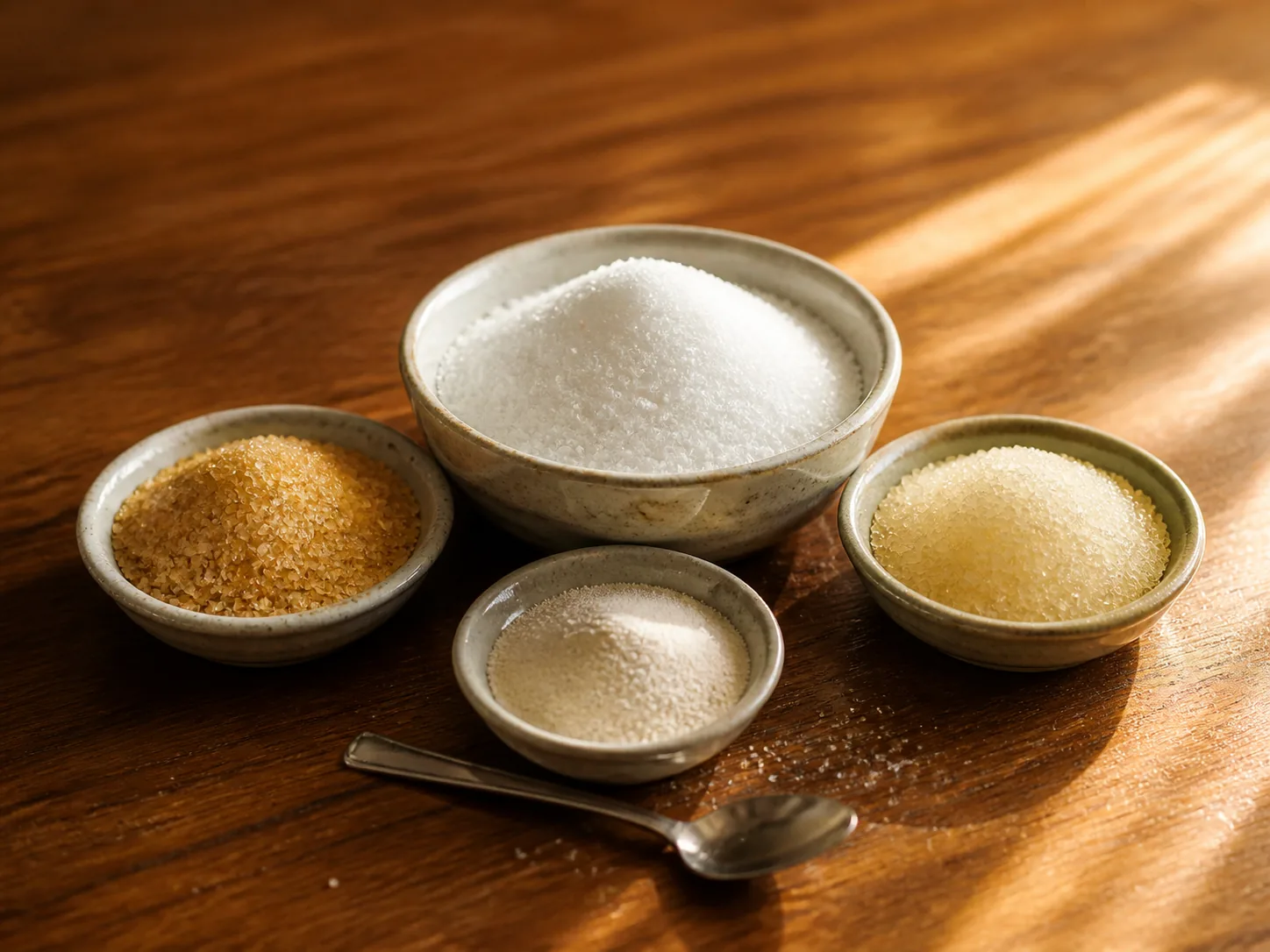
Sugar reduction is the practice of lowering the sugar content of a food or beverage while keeping it palatable, recognisable, and acceptable to the people who already buy it. It is a common reformulation brief in food and drink, and like salt reduction it is regularly underestimated, because sugar does far more in a product than taste sweet. The first thing a brief should settle is which sugar it means. Total sugars include the sugars naturally present in fruit and dairy as well as those added by the manufacturer; free sugars, the measure most health guidance is written against, are the added sugars plus the sugars in honey, syrups and fruit juice. The distinction matters, because a yoghurt and a soft drink can show similar total sugars while the health and reformulation questions they raise are completely different. Once the target is defined the difficulty becomes clear: sugar is doing several jobs at once, and lowering it touches all of them.
Why Sugar Reduction Matters in Australia
The health case is what keeps the pressure building. The World Health Organization recommends that adults and children keep free sugars to less than ten per cent of total energy intake, with a conditional further reduction to below five per cent for additional benefit, particularly for dental health. The Australian Dietary Guidelines run the same way, advising people to limit foods and drinks containing added sugars such as sugar-sweetened soft drinks, cordials and confectionery. Much of that added sugar reaches people through packaged products rather than the spoon at the table, which makes reduction a reformulation problem for manufacturers rather than a message for shoppers. There is a labelling incentive too: the Health Star Rating, the front-of-pack scheme developed by the Australian and New Zealand governments, scores packaged products partly on their sugar content alongside saturated fat and sodium, so a genuine sugar reduction can lift a product's star rating. The Australian numbers are not moving, either. The Australian Bureau of Statistics reports that "In 2023-24, per capita apparent consumption of free sugars was 66.4 grams per day, equivalent to 12.3% of all dietary energy available from sales of food and non-alcoholic beverages. This proportion was similar to 2022-23 (12.4%) and 2021-22 (12.3%) and exceeds the World Health Organisation's recommendation that free sugars make up less than 10% of dietary energy", and soft drinks went the wrong way across the year, "up 3.6 grams to 169 grams per day, a rise of 2.2%". Read that as a sales-based series rather than a diet survey: the ABS builds it from supermarket scanner data covering "around 78% of the value of sales of the food retail sector", it makes no adjustment for waste, and restaurant and takeaway meals are out of scope.
What Changed in the Rules in 2026
Two rule changes in 2026 settle questions a lot of briefs were still leaving open, and one of them is a closure. FSANZ ended its added-sugars labelling work on 23 March 2026: "On 23 March 2026, Food Standards Australia New Zealand (FSANZ) closed Proposal P1058. This followed an assessment that found requiring added sugars to be listed separately in the Nutrition Information Panel (NIP) was unlikely to deliver a clear public health benefit and could impose substantial costs across the food system." FSANZ states the consequence in the same place: "There are no changes to existing nutrition labelling requirements as a result of the decision to close Proposal P1058." Total sugars stays the only sugar figure the panel carries, which is also the figure the Health Star Rating algorithm reads. The second change is a tightening. From 30 April 2026, Amendment No. 249 re-cast the excluded-ingredient list for a no added sugar claim in Schedule 4, which now catches "(xiv) any of the following unless the food for sale is a prescribed beverage: (A) concentrated fruit juice; (B) concentrated vegetable juice; (C) deionised fruit juice; (D) deionised vegetable juice." A product sweetened with concentrated or deionised juice can no longer carry that claim unless it is a prescribed beverage. Separately, the Healthy Food Partnership's reformulation targets were reviewed and endorsed on 25 August 2026, and participation in that programme remains voluntary.
What the Sweetener Assessments Actually Say
The sweetener picture is where competitor pages most often go wrong, so it is worth separating what is settled from what is not. Monk fruit extract is not pending in Australia or New Zealand and has not been since application A1129, whose approval report is dated 13 November 2018 and whose purpose was "to permit monk fruit extract as a food additive, specifically as an intense sweetener"; nothing about it moved in 2026. Allulose is the opposite case. Application A1354, published 9 July 2026, seeks a permission for an enzyme "as a processing aid for the production of D-allulose", which is a permission to make the sugar rather than a permission to sell it. Two further sweetener applications, A1357 for rebaudioside M and rebaudioside D by enzymatic conversion and A1359 for a honey truffle sweet protein, were at administrative assessment only as at September 2026. No new sweetener was written into the Food Standards Code in 2026 at all. The international safety assessments published during the year mostly confirmed what was already in place, and each carries a qualifier worth keeping attached to it. JECFA left steviol glycosides where they were, recording that "The current ADI of 0-4 mg/kg bw, expressed as steviol, was confirmed." EFSA reconfirmed the acceptable daily intake "for aspartame of 40 mg/kg body weight per day". EFSA also kept sucralose at 15 mg/kg bw per day for its currently authorised uses, while expressly declining to clear it for baking, since on the evidence available it "could not conclude on the safety of the proposed extension of use of E 955 in this FC" given the uncertainty about chlorinated compounds forming across baking processes. And JECFA gave monk fruit extract only a temporary ADI, noting that estimated dietary exposure "exceeds the temporary ADI by approximately four-fold" against proposed international maximum levels rather than against products on shelf today. None of those are Australian permissions, but they are what a customer's technical team will be reading.
Why Sugar Is Hard to Remove
Sugar is hard to remove because sweetness is only part of what it does. It provides bulk and body, because sugar is a solid that fills out a recipe, and in baking and confectionery it contributes the structure, volume and texture that hold a product together, so taking it out leaves a real physical gap rather than only a flavour one. It governs mouthfeel and viscosity, which is why a full-sugar drink feels rounder and heavier on the palate than a watery reduced version. It drives browning and caramelisation, the reactions that give baked goods their colour and much of their cooked flavour. It depresses the freezing point of ice cream and frozen desserts, keeping them soft enough to scoop. It acts as a preservative by lowering water activity, which is central to jams, sauces and many shelf-stable foods. And it balances acidity and bitterness, rounding off sharp notes so the whole profile reads as pleasant. Remove the sugar and you change texture, colour, shelf life and flavour balance at the same time.
Why Swapping In a Sweetener Is Not Enough
The obvious move, replacing the sugar with a high-intensity sweetener, solves only one of those jobs. Sweeteners such as steviol glycosides and sucralose deliver sweetness at a tiny fraction of the dose, which means they bring none of the bulk, body or browning the sugar was also providing, so the product can end up thin, pale and structurally different. They also behave differently in time and character: many have a slower onset and a sweetness that lingers or builds, and several carry their own off-notes, a bitterness, a metallic edge, or in some stevia a liquorice-like note, that grow more obvious the more is used. The result of a straight one-for-one swap is usually a product that tastes sweet but wrong, with an odd sweetness curve, exposed off-notes and a body that has gone missing. Recovering the eating experience is where flavour work earns its place.
The Techniques, Used Together
Effective sugar reduction layers several techniques rather than relying on one. Sweetener systems are built as blends, combining sweeteners so their onset and decay smooth each other out and their individual off-notes partly cancel, instead of leaning on a single high-intensity sweetener. Bulking agents such as soluble fibres, polydextrose and certain polyols put back the mass, body and mouthfeel the removed sugar took with it, which matters most in baking and confectionery where the gap is physical. Flavour modulation and masking work on the taste directly, covering the bitter and metallic notes that sweeteners and reduced sugar expose, and using sweetness-enhancing flavours that raise the perception of sweetness so the same impact is reached from less sweetener. Gradual or stealth reduction lowers the sugar in small steps over time, each below the threshold most people can detect, so palates move with the product. Because every one of these methods has a ceiling, the practical answer combines them and tunes the mix to the specific product.
Where Sugar Reduction Matters Most
The categories that carry the most added sugar each behave differently. Sugar-sweetened beverages are the clearest target, both because they are among the largest sources of free sugars in the Australian diet and because the sugar there is mostly about sweetness and mouthfeel, which makes them responsive to sweetener systems and modulation, the work behind our beverage solutions. Confectionery and chocolate are the hardest case, because sugar is the structure as much as the sweetness, so reduction means rebuilding the body with bulking agents rather than only adjusting taste. Bakery has to manage sugar's effect on browning, moisture and crumb alongside flavour, so the product behaves differently in the oven. Dairy desserts, yoghurts and ice cream depend on sugar for sweetness, for freezing behaviour and for a creamy mouthfeel, so all three have to be defended at once. Sauces and dressings often use sugar to balance acidity, so cutting it can let sharpness through. The right approach depends entirely on which of sugar's jobs dominates in that particular product.
Common Questions
Two questions come up on almost every brief. The first is whether a reduced-sugar product has to taste artificial, and it does not, though avoiding it is the work: an artificial impression usually comes from an unbalanced sweetener with its off-notes left exposed, which is exactly what masking and a well-built sweetener system are there to prevent. The second is how far sugar can be cut, and the honest answer is that it depends on what the sugar is doing in that product. A beverage, where sugar is mostly sweetness and mouthfeel, can often go further than a biscuit, where sugar is also the structure and the colour. A useful brief sets the reduction against the category and the role sugar plays in it, rather than against a single number, and accepts that a large, stable reduction consumers still enjoy beats a bigger cut that fails on the shelf or in the mouth.
How VKA Australia Approaches Sugar Reduction
At VKA Australia we treat sugar reduction as a complete reformulation rather than the removal of one ingredient. That starts by analysing the current product to see what the sugar is actually doing in it, then rebuilding the parts flavour can rebuild: masking the off-notes that lower sugar and added sweeteners expose, using modulation and sweetness enhancers to recover perceived sweetness from less, and balancing the profile so the result tastes rounded rather than thin. We test in the real application through the real process, because a reduced-sugar recipe that works on paper can still fail in the oven or on the tongue, and we are clear about the limits: a flavourist can recover taste, but bulk, texture and preservation are formulation questions that have to be solved alongside, and the honest target is often a meaningful reduction that holds up rather than the largest cut possible. This work draws on our sugar reduction approach and sits beside the related briefs in salt reduction and fat reduction. If you have a sugar target to hit, talk to a flavourist directly and bring a sample of the current product so the profile can be rebuilt in the real thing.
Sources
- World Health Organization - WHO calls on countries to reduce sugars intake among adults and children
- Health Star Rating - Australian Government front-of-pack labelling system
- Australian Dietary Guidelines - Eat For Health (NHMRC)
- FSANZ Proposal P1058 - Nutrition labelling about added sugars, abandonment (closed 23 March 2026)
- Commonwealth of Australia Gazette FSC 189, Amendment No. 249, Schedule 4 items [16] and [17] (F2026L00481, gazetted 30 April 2026)
- ABS - Apparent Consumption of Selected Foodstuffs, Australia, 2023-24
- ABS - Apparent Consumption of Selected Foodstuffs methodology, 2023-24, scanner data coverage
- FSANZ Application A1129 - Monk Fruit Extract as a Food Additive, Approval Report 13 November 2018
- FSANZ Application A1354 - D-psicose 3-epimerase as a processing aid for the production of D-allulose (published 9 July 2026)
- JECFA 102nd meeting, Summary and Conclusions, additives table (meeting 9 to 18 June 2026)
- EFSA - Re-evaluation of sucralose (E 955) and the proposed extension of use in fine bakery wares, doi 10.2903/j.efsa.2026.9854
- EFSA - The salt of aspartame-acesulfame (E 962) is safe at current exposure levels, news item 10 September 2026
- Healthy Food Partnership Executive Committee Communique, Meeting 19, 25 August 2026